

How Is Turkish Law Proved in UK Courts? A Guide to Turkish Law Expert Witnesses
If a case in England or Wales turns on a point of Turkish law, the judge will need evidence of what that law says. That evidence normally comes from an independent Turkish law expert witness. This guide explains, in plain English, why foreign law has to be proved, when you need an expert, what the report must contain under CPR Part 35, and what it costs.
Why does Turkish law need to be proved in an English court?
English judges are experts in English law. They are not expected to know the law of other countries. For that reason, foreign law is treated as a question of fact. Just like any other fact, it must be proved with evidence.
If no one proves the foreign law, the court may simply apply English law instead. The Supreme Court explained this default approach in FS Cairo (Nile Plaza) LLC v Brownlie in 2021. The court can presume that the foreign law is similar to English law, but only where that is a fair assumption. For many Turkish law questions, such as matrimonial property regimes, reserved inheritance shares or tourism regulations, the two systems are very different. Relying on the presumption would be risky.
So if Turkish law matters to your case, it is safer to prove it properly with expert evidence.
What kinds of cases need a Turkish law expert?
Turkish law questions come up in many areas of UK litigation. The most common are:
Family cases, where a couple married in Turkey, owns property there, or signed a Turkish marriage contract.
Probate and inheritance, where the deceased was Turkish or owned land or money in Turkey.
Personal injury, where someone was hurt at a hotel or resort in Turkey and the court needs to know the local safety standards.
Commercial disputes, where a contract is governed by Turkish law, or a Turkish judgment needs to be enforced.
Immigration and document questions, such as whether a Turkish marriage, divorce or adoption is valid.
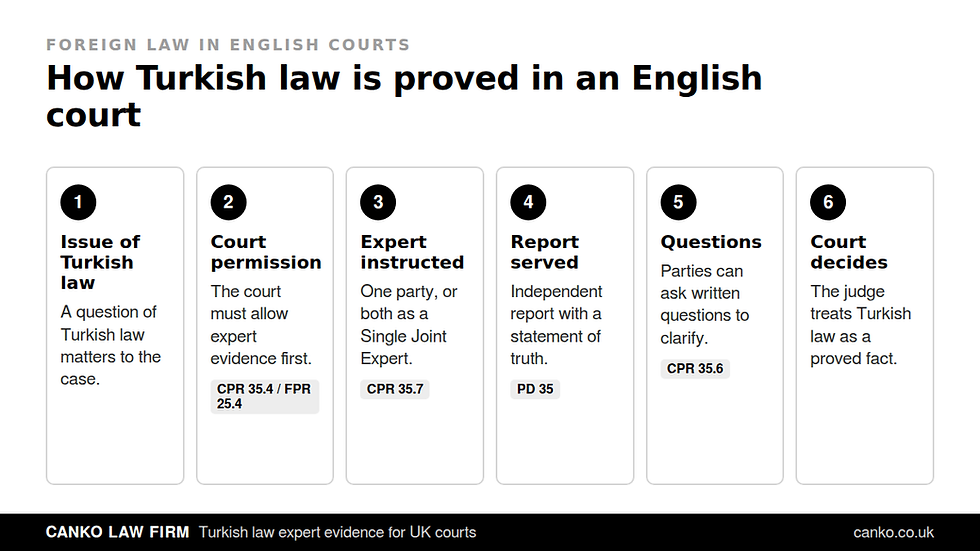
How do you get permission to use a Turkish law expert?
You cannot just file an expert report. The court must give permission first.
In civil cases
CPR 35.1 says expert evidence must be restricted to what is reasonably required to resolve the proceedings. CPR 35.4 says no party may call an expert or put in a report without the court's permission. When you apply, you must name the field of expertise and, where practical, the expert. It helps to set out the draft questions for the expert at this stage.
In family cases
FPR Part 25 applies. The test is stricter. The court will only allow expert evidence if it is necessary to assist the court to resolve the proceedings justly. Family courts also prefer a Single Joint Expert where possible, to keep costs down.
Party expert or Single Joint Expert?
There are two ways to instruct a Turkish law expert.
A party expert is instructed by one side only. The other side may instruct its own expert, and the two experts may later be asked to prepare a joint statement setting out where they agree and disagree.
A Single Joint Expert (SJE) is instructed by both parties together under CPR 35.7 or FPR Part 25. Both sides agree the questions, share the fee and receive the same report. This is cheaper and quicker, and it is very common for questions of foreign law.
Whichever route is used, the expert's duty is the same. CPR 35.3 says an expert's overriding duty is to help the court. That duty overrides any obligation to the person who instructs or pays the expert.
What must a Turkish law expert report contain?
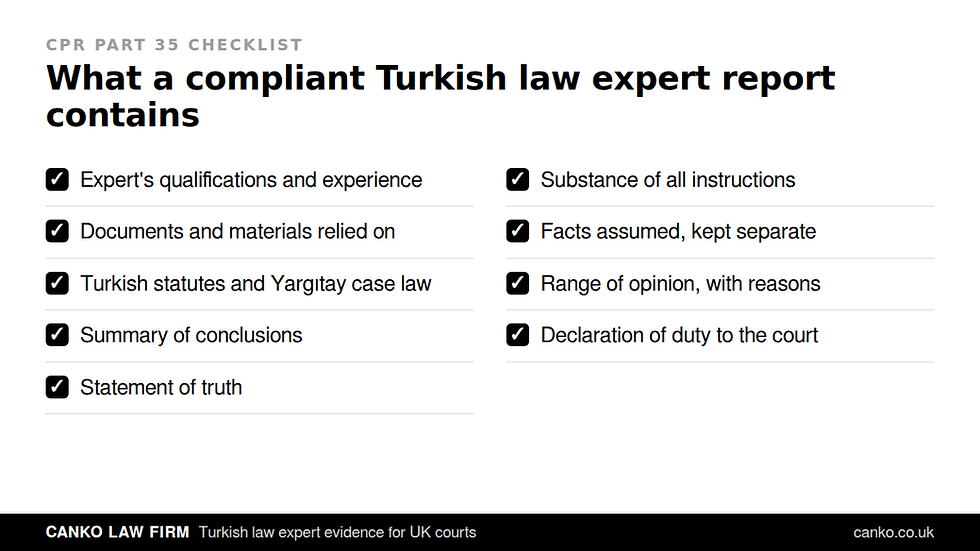
Practice Direction 35 sets out what an expert report in a civil case must include. Family reports have similar rules in Practice Direction 25B. In summary, a compliant report should:
give details of the expert's qualifications and experience
set out the substance of all material instructions
list the documents and materials the expert relied on
make clear which facts are assumed and which are within the expert's own knowledge
explain the relevant Turkish law, with references to statutes and case law
where there is a range of opinion, summarise it and give reasons for the expert's own view
give a summary of conclusions
include a statement that the expert understands and has complied with their duty to the court
end with the statement of truth required by the Practice Direction
A good Turkish law report does more than list statutes. It explains how Turkish courts actually apply the law, including the approach of the Turkish Court of Appeal (Yargıtay), which is Turkey's highest court for civil and criminal appeals. It also translates Turkish legal terms into ideas an English judge will understand.
Who can be a Turkish law expert?
The rules do not say that only one type of professional can give evidence of foreign law. The court looks at whether the person has the right knowledge and experience. In practice, the best evidence comes from someone who is qualified to practise law in Turkey and has real experience of the relevant area.
It also helps if the expert understands the English system. An expert who knows how English courts work can answer the questions the judge is really asking, and can avoid common problems, such as giving an opinion on the facts or straying into advocacy.
What happens after the report is served?
Once the report is served, the other side can put written questions to the expert. In civil cases, CPR 35.6 says questions must normally be put within 28 days of service and must be for clarification only, unless the court or the other party agrees otherwise. In family cases, FPR 25.10 sets a shorter timescale.
The expert's answers become part of the report. If two experts disagree, the court may order them to discuss the issues and prepare a joint statement. Sometimes the expert is asked to give oral evidence at a hearing, in person or by video link.
How much does a Turkish law expert witness cost?
Fees vary with the number of questions and the volume of documents. At Canko Law Firm our time is charged at £200 per hour, and we give a written estimate before we start so the parties know the likely cost in advance. Where we act as a Single Joint Expert, the fee is shared between the parties.
The court may limit the amount of the expert's fees that one party can recover from the other, so it is sensible to agree the fee early and include it in any costs budget.
How long does it take?
Most straightforward reports can be prepared within two to four weeks once the expert has the documents. We aim to send a draft within 14 days of receiving the fee and everything we need. Always tell the expert about court deadlines at the first contact.
Frequently asked questions
Is foreign law a question of fact or law in England?
It is a question of fact. That is why it must be proved by evidence, usually from an expert.
What happens if nobody proves Turkish law?
The court may apply English law by default, on the basis that Turkish law is presumed to be similar. That can produce a very different result from the true Turkish position.
Can the expert give an opinion on who is telling the truth?
No. A Turkish law expert explains the law. Deciding the facts and judging the witnesses is for the court.
Can a Turkish lawyer who is not in the UK be an expert?
Yes, if the court gives permission. But the report must still follow English procedural rules, so the expert must understand CPR Part 35 or FPR Part 25.
Do Turkish documents need to be translated?
The expert can read them in Turkish. If the court needs to see the documents themselves, certified translations are usually required.
Can I instruct an expert as a litigant in person?
Yes. You will still need the court's permission, and the expert will still owe their duty to the court.
Need a Turkish law expert?
Canko Law Firm prepares independent expert reports on Turkish law for civil, family and probate cases in England and Wales. Every report is prepared by two dual qualified lawyers. Find out more about our Turkish law expert witness service or email info@canko.co.uk.
About the authors: Can Canko is a Solicitor in England and Wales and an Attorney at Law in Turkey (Istanbul Bar). Pınar Canko is an Attorney at Law in Turkey and a Foreign Qualified Lawyer regulated by the Solicitors Regulation Authority.
This article is general information, not legal advice. It reflects the law on the date of publication.
